
BDSM & Our Shadow

It’s easy to reduce BDSM to a list of activities — latex outfits, foot worship, getting whipped — but those surface details miss the point. BDSM is less about acts than about understanding the why behind them. Figuring out why we do what we do helps us understand ourselves better and, in turn, live fuller lives in and out of kink.

I recently came across this Reddit post that captures that shift from shame to curiosity:
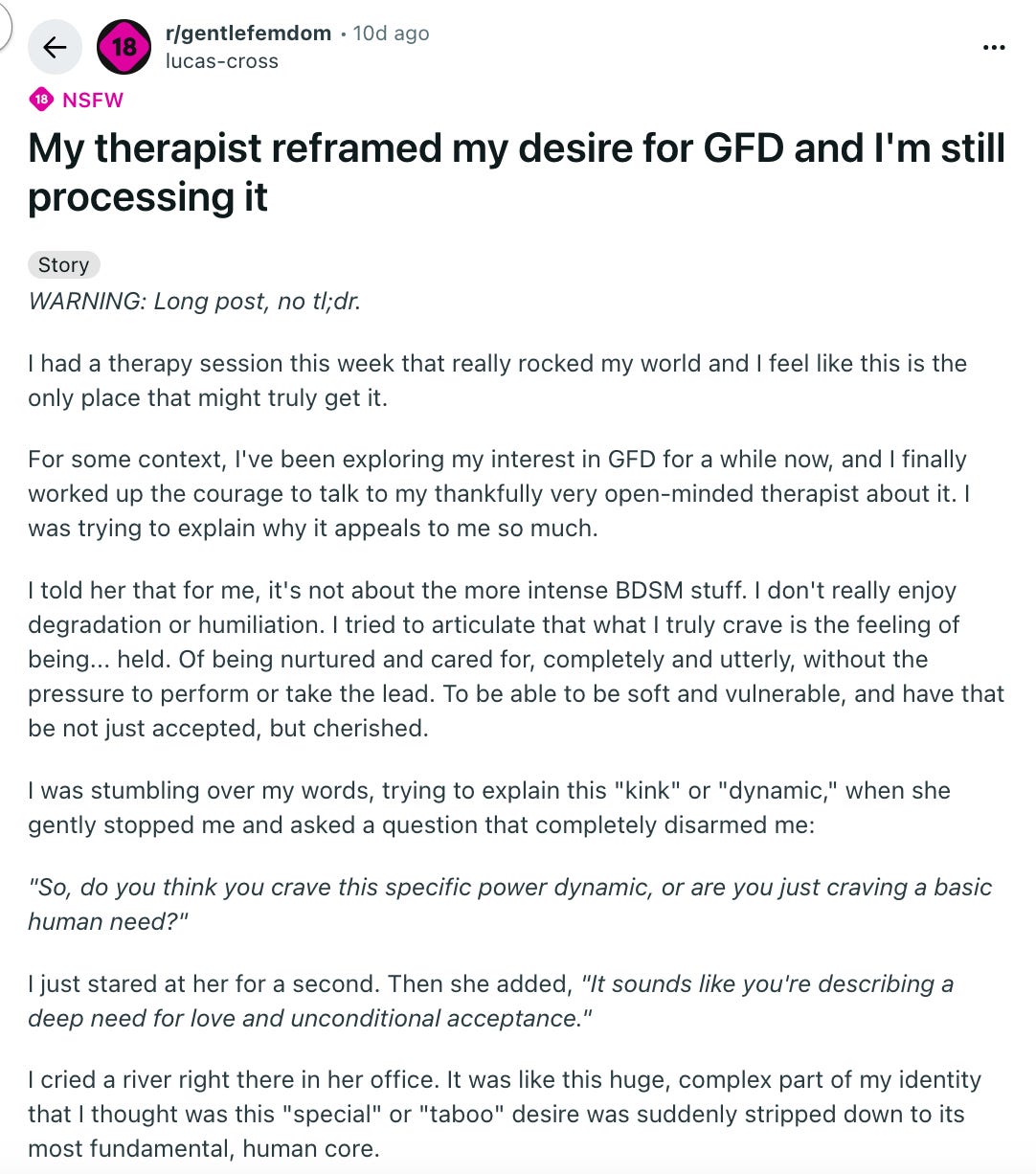
My therapist reframed my desire for GFD and I’m still processing it
byu/lucas-cross in gentlefemdom
Carl Jung theorized the unconscious as a vital part of human psychology. According to Jungian ideas, our unconscious houses the experiences and impulses we couldn’t hold or make sense of when we were young. These could be absent parenting, intergenerational trauma, failed relationships, recurring dreams, anxieties, and other fragments that never found a place in conscious life. Over time we build defences around these fragments — habits, identities, achievements, compulsions — to supress or manage them so we can function. Jung called some of this material the “shadow”: parts we deny or disown, not because they’re inherently bad but because they felt dangerous or shameful, or we simply couldn’t make sense of.
Everyone has a shadow self, what differs is how much of it we can recognize and talk about. For some people that buried material remains background noise; for others it actively shapes choices into adulthood without their awareness. Jung’s work isn’t an invitation to blame childhood for everything, but it offers an introspection: many adult compulsions — the people we pick to live our lives with, the roles we prefer, the patterns of craving or withdrawal — can often be traced back to early unmet needs or adaptive strategies that once kept us safe.
For example, inconsistent or unpredictable parenting during childhood, can lead to children growing up with a deep-seated fear of abandonment in adult relationships, developing a constant reliance on reassurance from partners. Psychologists call this an anxious attachment style. You may see patterns of people-pleasing traits, emotional hypersensitivities, or a constant fear of abandonment in them. If left unchecked, this can cause anxiety and difficulty building and maintaining meaningful relationships with partners. Of course, trauma can also express itself through seemingly ‘healthy’ appearances: running marathons, maintaining a hyperactive social life, or chasing achievements. These can be adaptive behaviours that mask an unresolved need. On the surface they look constructive, but underneath they’re coping strategies — socially sanctioned ways to fill a hollow we’ve forgotten how to name. In kink, the unconscious self can surface as sexual shame: the feeling of being inherently bad, flawed, or unworthy due to one’s sexuality, including their identity, kinks, or behaviours.
When we insist on denying our shadow side, that doesn’t mean it goes away, in fact, it often grows stronger. I believe we can draw a straight line from certain adult behaviours back to our childhood. Some people seek answers and find them; many others don’t even know what the questions were in the first place.
The way forward
Responsible play — negotiated, informed and consensual — can be a powerful mirror. While not a replacement for therapy, kink can point to places that need work. When exploring kink within a scene, respond with curiosity, not nonchalance nor shame: notice what showed up repeatedly, name it, sit with it, and seek support if it’s more than you can hold. One thing I like to do with clients is to respond to a ‘why’ at least three times when they share something about themselves with me. Each strip away a layer of assumptions and lazy reasoning.
“I have a crossdressing kink.”
“Why?”
“Hmm, I like dressing up in female clothes; dresses, lingerie, high heels and makeup.”
“Why?”
“Hmm, good question. I guess I like seeing how feminine I can be.”
“Why? Does it arouse you, or does it feel more empowering for you?”
“I never thought of it. I guess when I was young, my mom put on a dress for me once because she wondered how it was like to have a daughter, and that image stuck with me since then. I think I liked the attention”
“Why?”
The point isn’t interrogation; it’s excavation.
Each why opens a door, sometimes to pain, sometimes to recognition.
So, here’s a practical, non-moralizing takeaway: treat your desires as clues, not faults. Ask questions before and after scenes, be honest with partners about what you’re like and trying to learn and keep safety and common sense at the core — the practical (first aid, safe words, hygiene) and the human (aftercare, debriefs, check-ins, follow-ups). If a pattern keeps repeating — whether it’s chasing affection through mindless submission, or masking emptiness with taste for risky kinks — follow it back with curiosity, not ignorance, not shame. Why do I like them? That’s where kink becomes more than a list of acts: it becomes a practice of self-knowledge and a chance to live fuller lives.
