
丞相保重
Chengdu, Red Rum, and Those Who Stay

History tells us many things.
It tells us that Zhu Di (朱棣, 1360 - 1424 AD) was unhappy that his father, the Emperor, left his throne to his grandson, after his son, the appointed heir died. After his father died, he launched a civil war to take the throne from his nephew, usurping the throne and massacring thousands who refused to recognise his legitimacy.
It also tells us that Liu Bang (劉邦, 256 - 195 BC), the founding Emperor of the Han Dynasty, disposed three of his most accomplished generals after his ascension to the throne. He coined it, killing the hunting dogs after the hares had been caught, so that they could no longer pose a threat to him or his son’s reign in the future.
History is a record of what power does to people who are near it. Zhu and Liu, in particular, weren’t villains; on the contrary, both were recognised as great rulers in ancient Chinese history. They were just honest about the arithmetic of power. Power is not stable nor safe when distributed or shared. Proximity to it changes people. Dependence on it changes people. Ambition near it dissolves obligations, oaths and commitments that once were permanent.
I came to Chengdu intentionally. The history of the Three Kingdoms (220 - 280 AD) had been sitting with me long enough that the distance between the page and the place started to feel like the only thing left.
Wuhou Shrine (武侯祠) sits in Chengdu, the ancient capital of the Shu Han Dynasty of the Three Kingdom Era, and it was the last piece of the history that I had to see for myself. The shrine was dedicated to Zhuge Liang (諸葛亮, 181 - 234 AD), its beloved chancellor.
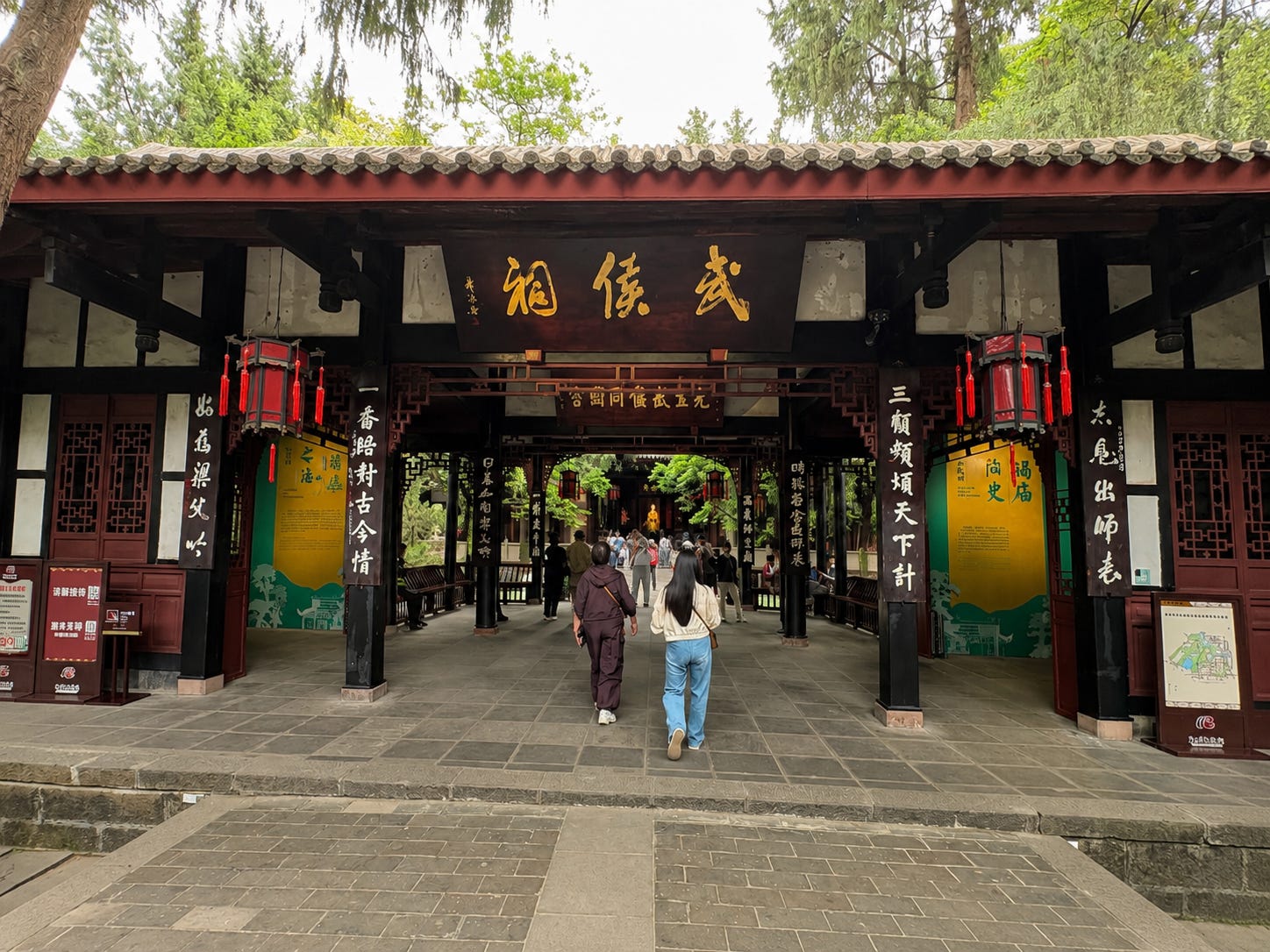
The shrine was technically built for Liu Bei (劉備, 161 - 223 AD) — Emperor (of the Shu Han Dynasty), and the man whose vision Chancellor Zhuge served for 27 years. But everyone comes for the chancellor. Liu’s hall sits higher on the grounds, as ancient Chinese protocol requires: no one can be higher than the Emperor. But Chancellor Zhuge draws the crowd and the flowers at the altar. There is something romantic about that. What people come looking for, I think, is for this person who falls entirely outside the arithmetic of power.
In the second half of the Chancellor's tenure, he governed the regency for a child emperor — Liu Bei's son — who could not have stopped him from taking everything. He took nothing. Not the throne. Not riches, land, nor prestige; nor did he install his family into positions of power. What he did instead was work. He reviewed every administrative decision and policy planning himself, not because he didn’t trust his subordinates, but because he could not bring himself to put down what Liu had entrusted in him. He reclaimed Southern China for the kingdom, then launched five northern expeditions to honour a promise made to the late Liu to reunify China, knowing the meagre odds, and died on the last one at Wuzhang Plains, still trying. There is a line from his writings: 鞠躬盡瘁,死而後已 — I will exhaust my last efforts and die in the endeavour. He meant it. That is the unsettling part. Not the accomplishment, not the military strategy, but the fact that he meant it — and that meaning it, in the end, is what killed him.
Wuhou Shrine has been rebuilt, expanded, and commemorated across different empires that had no political reason to care about the chancellor of a short-lived kingdom. People have been coming for centuries to the shrine not to study history but because history struggles to hold what the Chancellor meant to them. People want proof that it is possible to be near power and remain uncontaminated by it. to choose fidelity, loyalty and commitment over power, which does not simply disintegrate or erode.
People romanticise the Chancellor because the alternative is that the Zhus and Lius are simply correct, that power absolutely corrupts, that fidelity always collapses, that the arithmetic always wins, and that is a loneliness too harsh to accept. What they are looking for is the romance of a loyalty and commitment that was freely chosen and held until the very end.
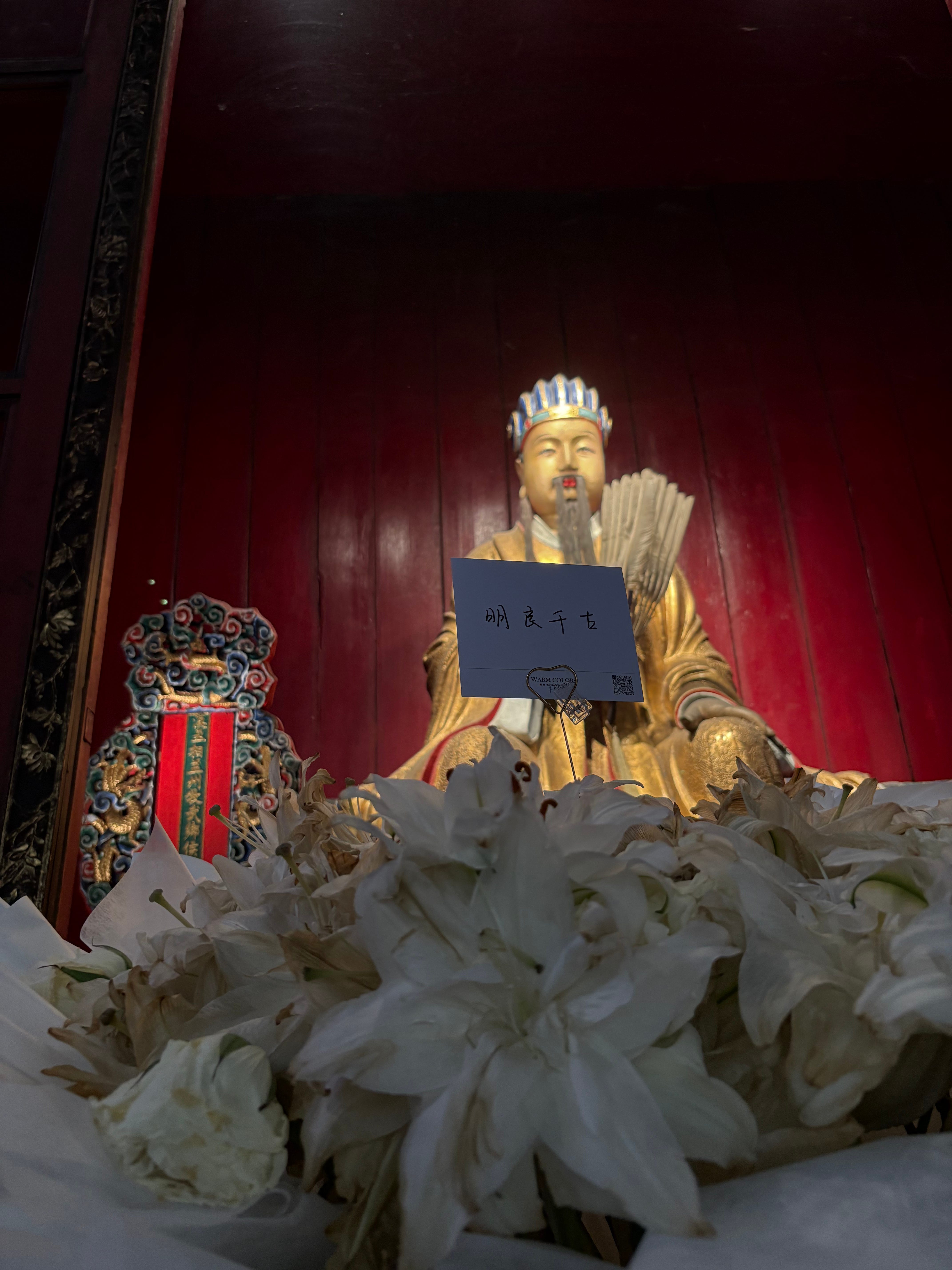
Standing at the shrine, I did not learn what I didn’t already know. The statues of Chancellor Zhuge and his sons, the plaques dedicated to him, the traditional 榫卯/mortise-and-tenon joinery construction, flying eaves roofings, typical of ancient traditional architecture, were what I already expected. But amidst the bustle of the crowd and the Chengdu noon heat, I found myself thinking of something else completely.
I was thinking what it meant to have built something with people who could have left, but didn’t. The kind of thing that only works because of who is in it with you, and that would probably not have survived being in it with someone else. Lilith stayed through a thing she didn’t have to stay through. Delilah showed up when showing up was inconvenient. Many others within my circle, including did the thing that people who are quietly running their own calculations do not do.
It’s easy to live in an idealistic world, to simplify relationships that if you build things carefully and maintain it, treat people well by sharing gains and power and they would stay; everybody makes that mistake. A more cynical reality is that everyone is, at the very end, looking after their own. Alliances are provisional. Promises and commitment are conditional. When the stakes are high enough, the arithmetic always wins. The thirst for power always wins. History supports this; just like the Zhus and Lius of the world. The exceptions, like the Chancellor, are exceptions precisely because they are so rare that people build shrines for them and still visit him centuries on.
There is no mainstream category for what Lilith and Delilah are to me. The mainstream doesn’t have a term for people who built something with you in the margins, who carry the specific knowledge of your work and what it costs, who show up not because any structure or rules require them to but because they have decided they want to. There is no protocol that put them in my life and no protocol that keeps them in it. Just the choice. Made and remade, with full information, in the direction of staying.
The Wuhou shrine exists because people recognized, across centuries and multiple dynasties, that what the Chancellor did could not be explained easily. That it deserved its own space. That some things hold not because of blood or obligation or the accident of proximity or luck, but because the person doing the holding decided that they would, and kept doing it.
I came to Chengdu to stand inside a piece of history I already knew. I did not expect to find it coming back at me.